



Digital Signatures
Who Really Signed It? How Digital Signatures Work
A signature on paper connects a person to a document. But when the document exists only as a digital file, and there is no pen, paper or physical mark to examine, how do we know who signed it?
A digital signature solves this differently. It does not reproduce a handwritten signature. Instead, it uses cryptographic technology to authenticate an electronic record and create a verifiable link between the signature and the document.
Understanding How a Digital Signature Works
Under India’s Information Technology Act, 2000, a subscriber can authenticate an electronic record by affixing a digital signature. It uses asymmetric cryptography and a hash function to authenticate an electronic record.
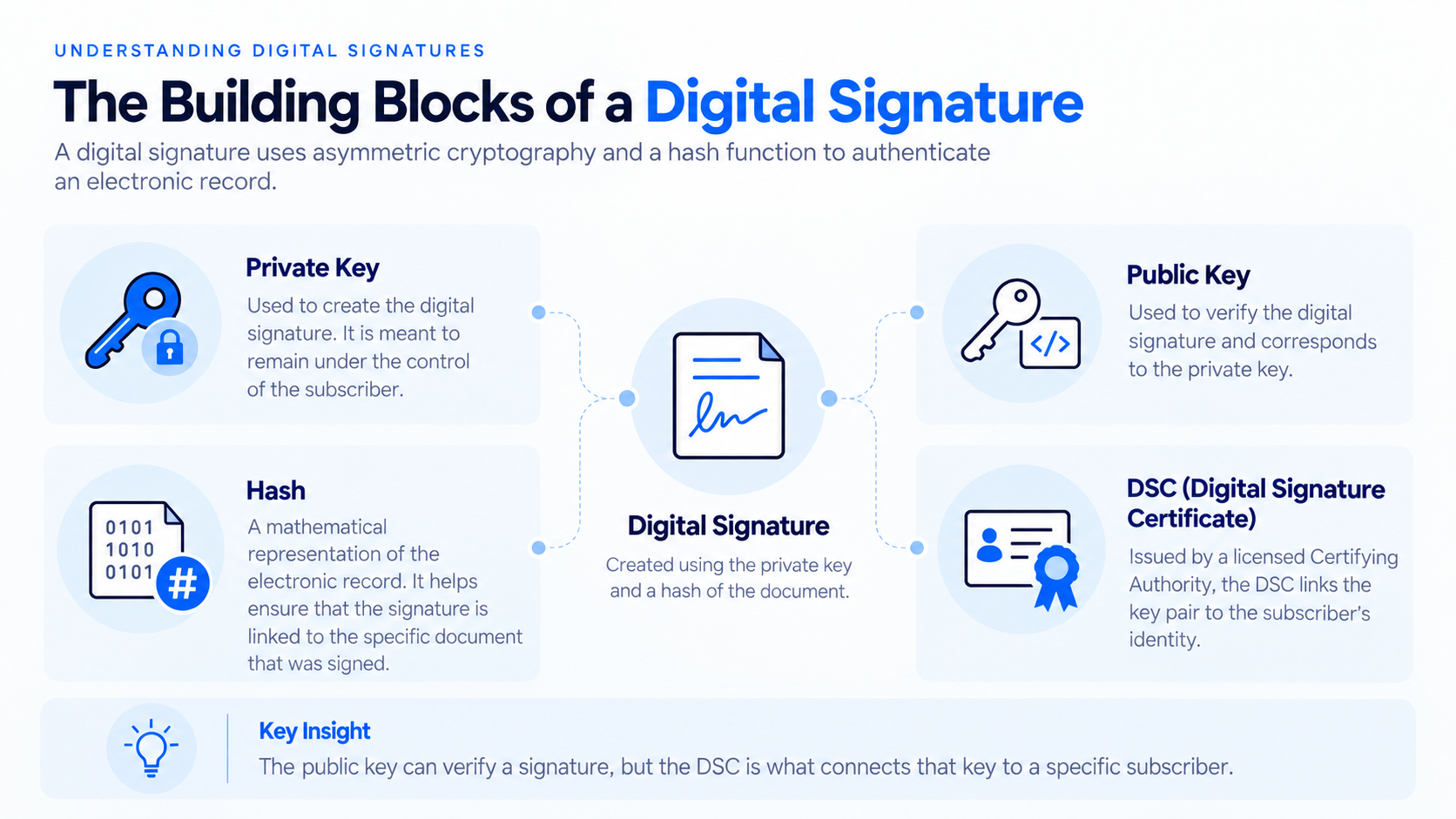
At the center of this process is a pair of mathematically related keys:
-
Private key: Used to create the digital signature. It is meant to remain under the control of the subscriber.
-
Public key: Used to verify the digital signature and corresponds to the private key.
-
Hash: A mathematical representation of the electronic record. It helps ensure that the signature is linked to the specific document that was signed.
The private key creates the signature, while the corresponding public key allows others to verify it. The hash helps the verification process detect whether the electronic record has remained unchanged after signing.
The public key alone does not tell us who owns it. That connection comes through the Digital Signature Certificate (DSC), issued by a licensed Certifying Authority.
But can we verify who the signature belongs to, and whether the document is still the same one that was signed?
Note: Not sure how a DSC differs from eSign? Read our guide to DSC vs eSign to understand how the two work and where they fit into digital signing.
What Does a Digital Signature Actually Prove?
A valid digital signature helps establish two important things:
It establishes who the signature is linked to
The signature can be traced to the key pair associated with the signer’s DSC, creating a verifiable link to the subscriber's identity.
Holds proof that the signed electronic record has not been altered after signing.
Verification checks whether the electronic record remains intact or has been changed since the signature was applied. But there is another important layer.
The public key is included in the Signer’s DSC. The DSC is issued by a Certifying Authority (CA) licensed by the Controller of Certifying Authorities (CCA). Before issuing a DSC, the CA follows prescribed identity-verification requirements.
That is what makes a digital signature more than an electronic picture of a handwritten signature.
How Does Digital Signing Work? A Simple Step-by-Step Flow
The process can sound highly technical, but the underlying idea is straightforward.
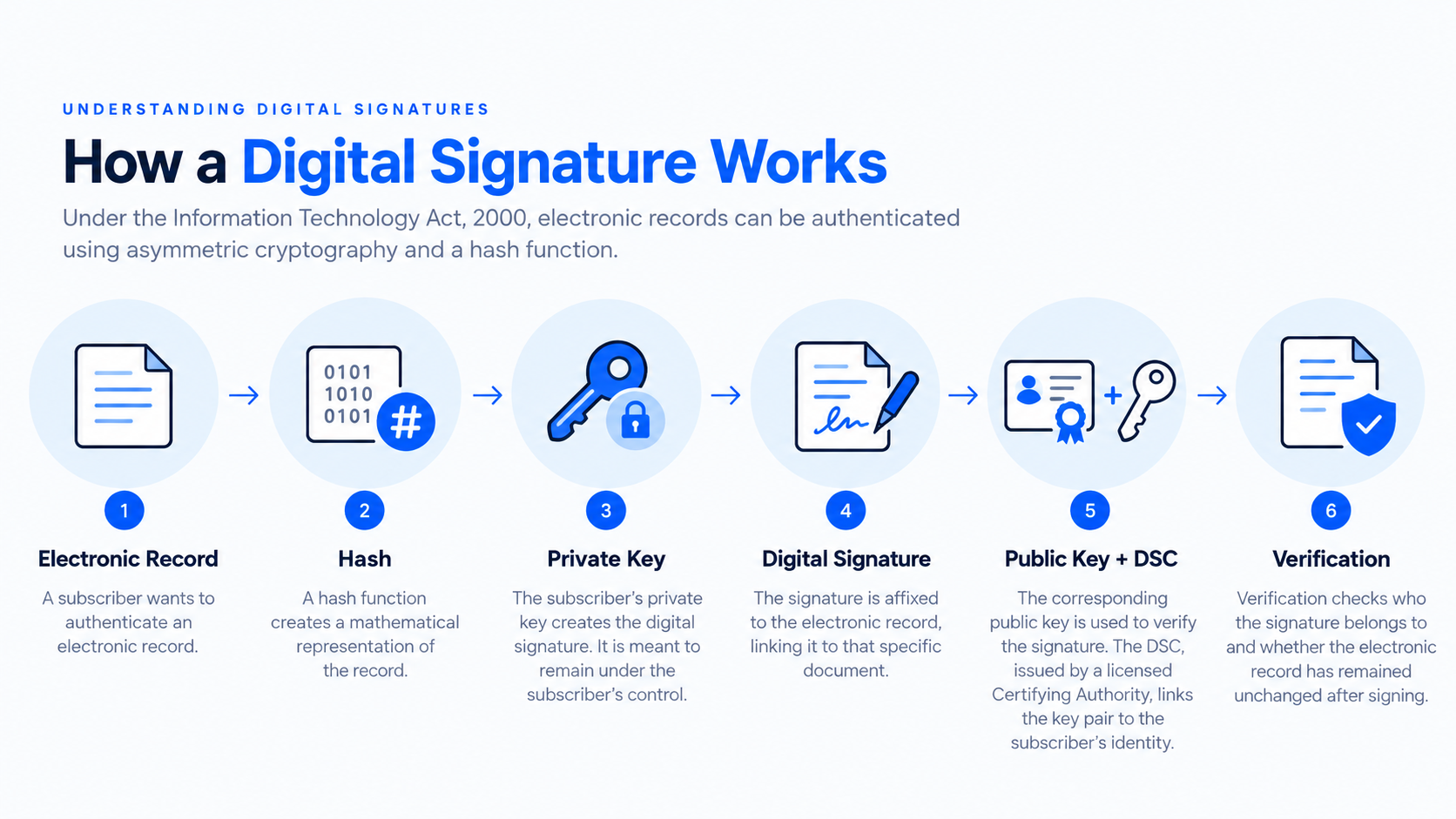
Step 1: The document is prepared
A document is finalized and submitted for digital signing.
Step 2: A hash is created
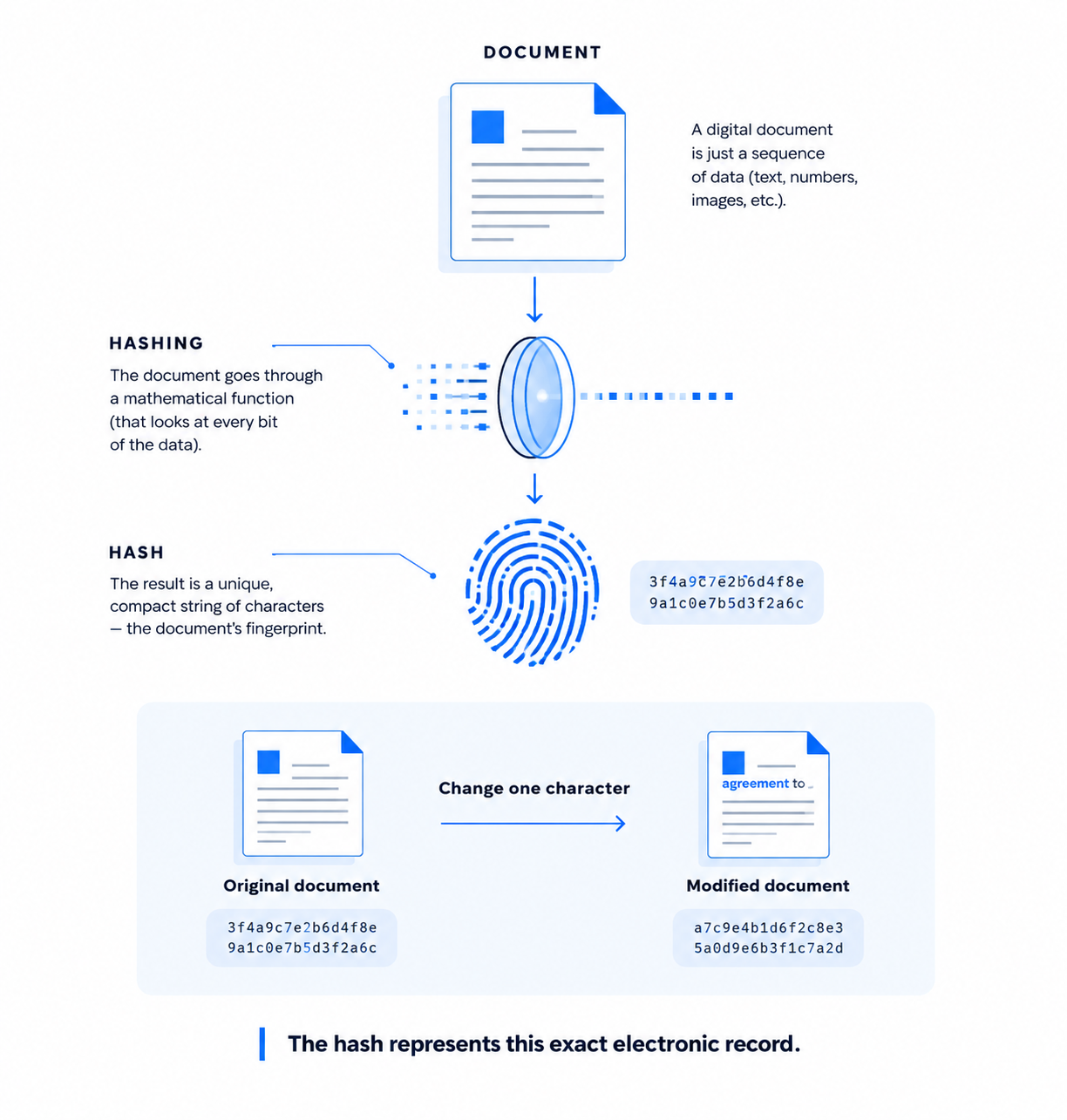
The signing software applies a hash function to the electronic record.
Think of a hash as a digital fingerprint of the document. The IT Act’s rules describe the hash result as a value that is, for practical purposes, unique to the electronic record.
Step 3: The private key creates the signature
The hash result is transformed using the signer’s private key. The resulting digital signature is unique to both the electronic record and the private key used to create it.
This distinction is primal because a signature is not simply a reusable image. It is mathematically connected to the particular document being signed.
Step 4: The document and signature travel together
The digital signature is attached to the electronic record and stored or transmitted with it.
Step 5: The recipient verifies it
The verifier uses the signer’s public key and calculates a fresh hash of the document.
The verification process checks two things:
-
Was the signature created using the corresponding private key?
-
Does the newly calculated hash match the original signed hash?
If both checks succeed, the signature can be verified.
The CCA further explains that verification requires the signer’s certificate and the relevant certificate chain up to the Root Certifying Authority.
Why Can't You Simply Copy a Digital Signature?
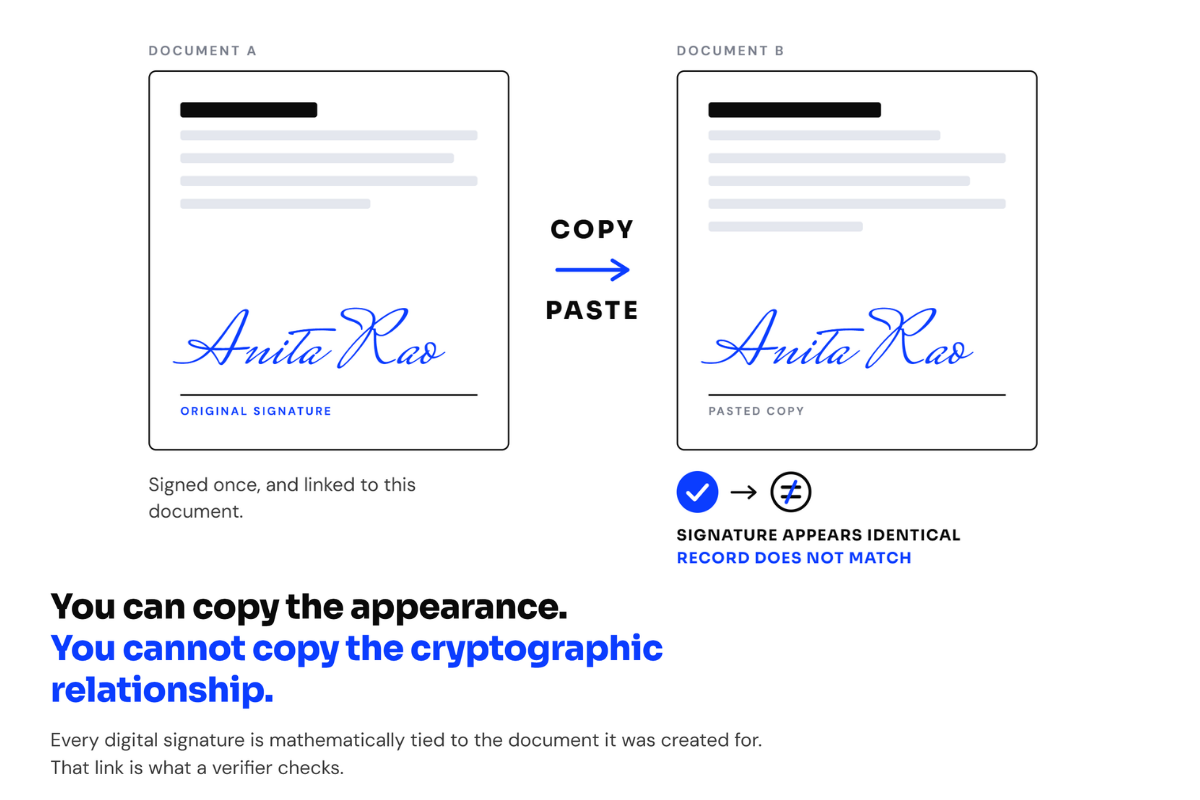
This is one of the biggest differences between a digital signature and a scanned image of a handwritten signature.
A picture of a signature can be copied and pasted.
A digital signature cannot simply be copied from one document and expected to remain valid on another document.
Why?
Because the digital signature is connected to the specific electronic record that was signed and to the signer’s private key. Change the underlying record, and the verification process can detect the mismatch.
The CCA puts this even more clearly: there is no fixed “specimen digital signature” like there is with a paper signature. A digital signature changes with the content of the message.
That is why copying the visible appearance of a digital signature does not reproduce the cryptographic signature itself.
What Happens If a Signed Document Is Changed?
Suppose a contract is digitally signed.
After signing, someone changes:
-
a payment amount
-
a date
-
a clause
-
a name, or
-
another piece of signed content.
The document may still open normally.
It may even look perfectly legitimate.
But the cryptographic verification can reveal that the document no longer matches what was originally signed.
Why?
Because the document's newly calculated hash will no longer match the hash associated with the original digital signature. The IT Act's verification framework specifically requires checking whether the electronic record has remained intact or has been altered.
This is where digital signatures provide something a pasted signature image cannot: detectable integrity.
Does a Digital Signature Prove Everything About the Transaction?
No.
And this distinction matters.
A digital signature can establish important facts about the electronic record and the signature. But it should not automatically be treated as proof of every fact surrounding the transaction.
For example, a valid digital signature does not by itself answer every question about:
-
whether the signer had the appropriate business authority
-
whether the underlying commercial terms were lawful
-
whether the signer understood every commercial consequence
-
whether the transaction was entered into under proper organizational processes; or
-
what happened outside the signed electronic record.
The CCA itself distinguishes between authentication and other questions surrounding a transaction. Its framework describes digital signatures as carrying the concepts of identification, declaration, and proof into the electronic environment.
There is also an important security responsibility on the signer.
The private key must be protected.
The CCA's guidance states that where the hardware cryptographic device containing signature-creation data is in the subscriber's custody, a signature created using that device and verifiable through the subscriber's DSC is deemed to be the subscriber's signature. The CCA also notes that if a private key is not stored securely, it can potentially be misused to sign an electronic record without the owner's knowledge.
So digital trust does not end when the signature is created.
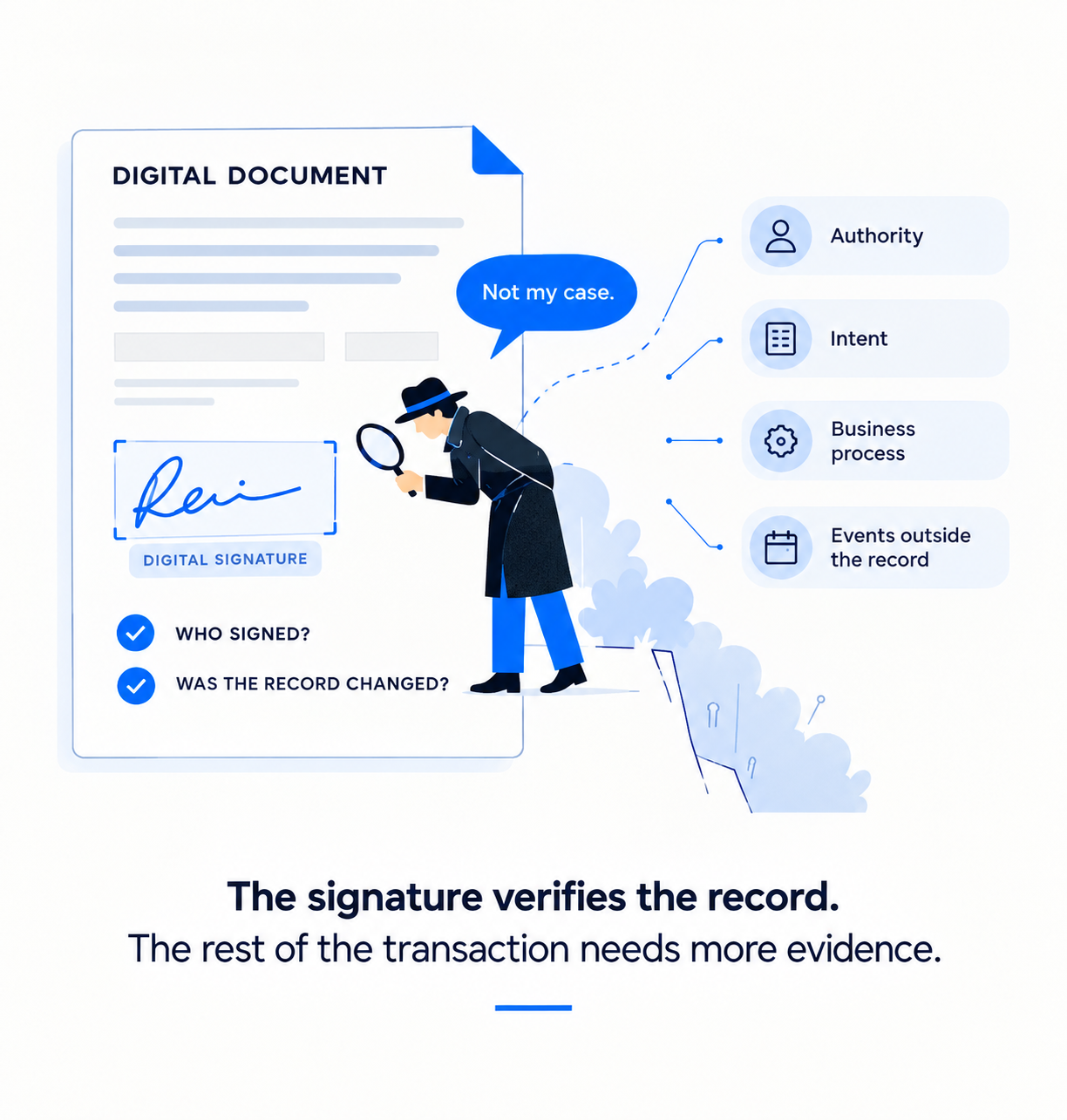
Identity verification, certificate validity, private-key control, document integrity and verification all matters.
The Bigger Picture: A Signature Is One Layer of Digital Trust
The legal recognition of digital signatures in India is not based on simply replacing an ink signature with a digital image.
It is based on a technical and regulatory framework that connects:
Identity → Certificate → Key Pair → Signature → Document Integrity → Verification
But as digital transactions become more complex, the signature itself is only one part of the trust infrastructure around a transaction. Because digital trust goes beyond the signature itself.
Note: Explore what digital trust is to understand the wider framework that makes digital interactions reliable, verifiable, and accountable.
The stronger approach is to build evidentiary layers into digital transactions from the start; capturing the relevant information needed to establish what happened, who was involved, and whether the record remained intact.
That matters because evidence should not have to be reconstructed only after a dispute arises. Trust is stronger when the evidence needed to support it is built into the process from the beginning.
For businesses, government services and digital transactions, this is the next step in digital trust; moving from simply signing a document to building transactions that can be verified, understood and evidenced when it matters.
Frequently Asked Questions
1. Is a digital signature legally valid in India?
Yes. The Information Technology Act, 2000 provides legal recognition to digital signatures, and the CCA states that digital signatures are accepted at par with handwritten signatures under the applicable framework.
2. Does a digital signature prove who signed a document?
It provides a verifiable connection between the digital signature, the corresponding private/public key pair and the subscriber information contained in the Digital Signature Certificate, subject to the certificate and key being valid and properly controlled.
3. Can someone copy and paste my digital signature?
A copied visual representation is not the same as the cryptographic digital signature. A digital signature is linked to the specific electronic record and the private key used to create it.
4. What happens if someone edits a digitally signed document?
The verification process can detect that the signed content has changed because the newly calculated hash will no longer correspond to the value associated with the original signature.
5. What is the role of a Digital Signature Certificate?
A DSC associates a subscriber's identity information with a public key. Certifying Authorities issue DSCs after following prescribed verification processes, creating a trust link between the identity and the cryptographic key used for verification.
6. What if a digital signature certificate has expired?
The CCA states that signatures are verified with respect to the time at which the signature was affixed. A signature made while the certificate was valid can remain valid even if the certificate subsequently expires, subject to the applicable verification requirements and evidence available.
7. Is a digital signature the same as an electronic signature?
Not exactly. The IT Act recognises electronic signatures more broadly under Section 3A, while the traditional digital-signature mechanism under Section 3 specifically uses asymmetric cryptography and hash functions.
8. Is a digital signature enough to prove that a transaction was authorised?
Not necessarily. A digital signature can authenticate the electronic record and associate it with the relevant certificate/key framework, but questions of authority, consent, business process and the circumstances of a transaction may require additional evidence.